The Complete Guide to Pearls: Everything You Need to Know About June’s Birthstone

Elegant, versatile, and completely natural, pearls have been loved for centuries. As the birthstone for June, they’re also one of the most distinctive gems in jewellery because, unlike diamonds or sapphires, pearls are formed inside a living creature rather than mined from the earth. You can also explore our full guide to birthstone jewellery by month to discover the meaning behind every birthstone.
In recent years, pearls have made a huge comeback. While classic pearl necklaces will always have their place, modern pearl jewellery feels far more wearable and contemporary than many people expect. From simple pearl studs to organic baroque designs and layered necklaces, pearls now work just as well with everyday outfits as they do for special occasions.
In this guide, we take a closer look at the history of pearls, how they form, the different types available today, and what to look for when choosing pearl jewellery.
Pearls Through History
Pearls have fascinated people for thousands of years. Long before cultured pearls existed, natural pearls were incredibly rare, which made them symbols of wealth, royalty, and status.
In Ancient Rome, pearls were considered one of the ultimate luxury items, while in Medieval Europe they often appeared on crowns, ceremonial robes, and royal jewellery collections. Their rarity made them highly prized, especially amongst nobility.
By the Victorian era, pearls had taken on a more sentimental role and were often given as gifts to symbolise love, purity, or remembrance.
Then came the glamour of the 1920s. Long pearl necklaces became one of the defining looks of the decade, perfectly complementing the elegant silhouettes and Art Deco styling of the era.

A classic string of pearls was the ultimate symbol of 1950s sophistication
Pearls remained fashionable throughout the 1950s and 60s too, thanks in part to style icons such as Audrey Hepburn, Jacqueline Kennedy, and Coco Chanel. Audrey Hepburn’s pearls in Breakfast at Tiffany’s are still amongst the most recognisable jewellery looks in film history.
Although pearls were once unfairly labelled as overly traditional, modern jewellery designers have completely changed that perception. Today’s pearl jewellery often combines mixed metals, minimalist settings, asymmetrical shapes, and contemporary styling that feels fresh rather than formal.
How Are Pearls Formed?

The careful extraction of a pearl reveals one of nature’s most treasured gems
One of the reasons pearls are so fascinating is that they form naturally inside oysters, mussels, and other molluscs.
A pearl begins when a tiny irritant, such as a fragment or parasite, enters the shell. To protect itself, the mollusc coats the irritant in layers of nacre – the same material that lines the inside of the shell and gives pearls their soft glow. Over time, these layers build up to create a pearl.
Natural pearls are exceptionally rare. Historically, pearl divers would search thousands of oysters in the hope of finding just one pearl of jewellery quality. That rarity is a huge part of why pearls became associated with royalty and luxury for so many centuries.
What Are Cultured Pearls?
Most pearls used in jewellery today are cultured pearls rather than natural pearls. Despite the name, cultured pearls are still real pearls. The difference is simply that the process begins with a small amount of human assistance. Pearl farmers carefully place a tiny nucleus inside the mollusc to encourage pearl formation, and the mollusc then naturally produces nacre around it.
Without cultured pearls, pearl jewellery would be far rarer – and far more expensive.
The modern cultured pearl industry was pioneered by Kokichi Mikimoto in Japan during the late 19th century. His work transformed pearls from extremely rare treasures into gemstones that far more people could enjoy and wear.
Today, cultured pearls are available in a huge variety of colours, sizes, and styles, from classic white pearl earrings to dramatic Tahitian pearl necklaces.
Freshwater and Saltwater Pearls
Cultured pearls are usually divided into two categories: freshwater pearls and saltwater pearls.
Freshwater Pearls
Freshwater pearls are grown in mussels in lakes, rivers, and ponds, most commonly in China. They are popular because they are versatile, affordable, and available in a wide range of shapes and soft natural colours. White remains the classic choice, although pink, peach, and lilac tones are also common.
Freshwater pearls are often slightly less expensive than saltwater pearls because mussels can produce several pearls at once. They’re ideal for everyday jewellery and work beautifully in pearl stud earrings, bracelets, pendants, and layered necklaces.
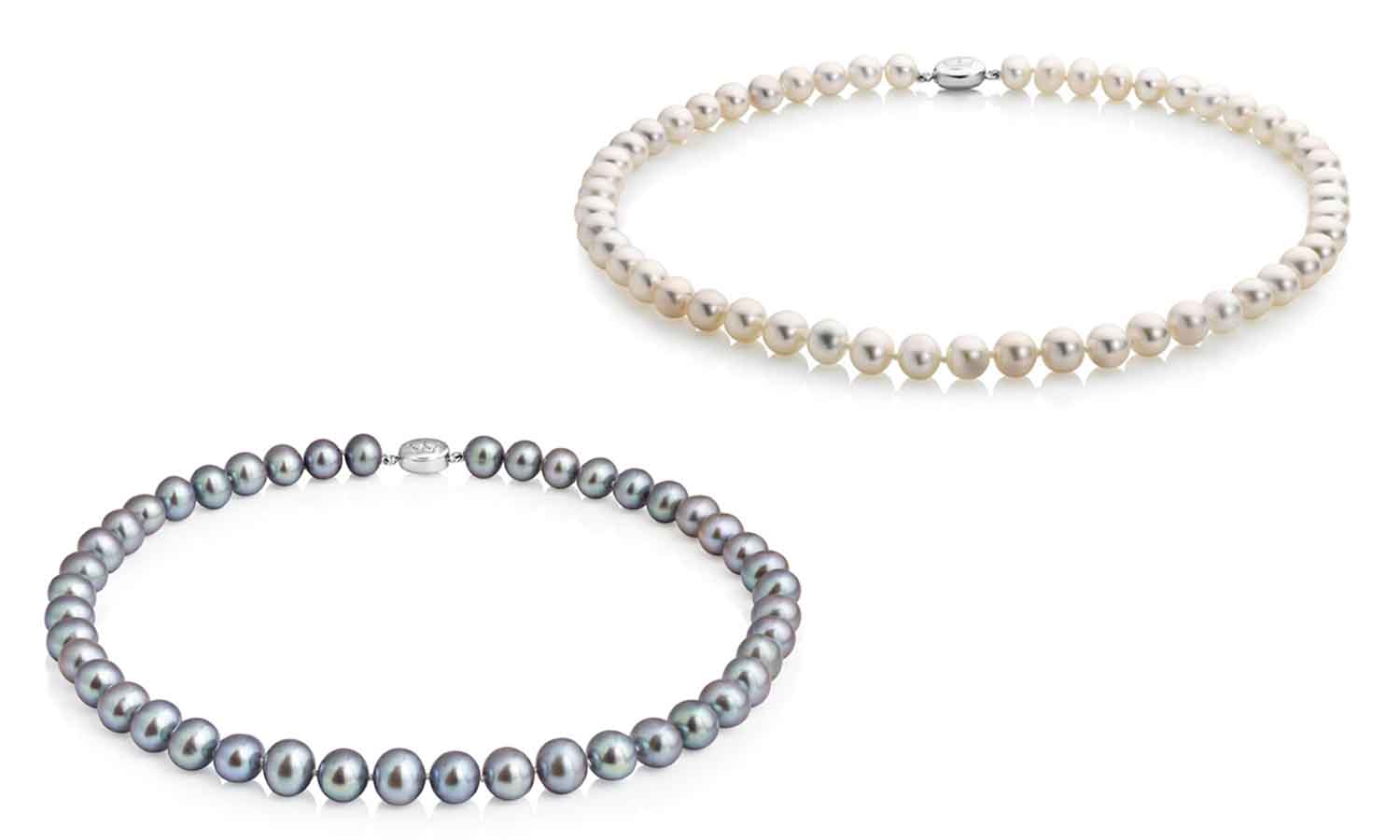
Jersey Pearl Classic Freshwater Pearl Necklace and Grey Freshwater Pearl Necklace
Saltwater Pearls
Saltwater pearls are grown in oysters in coastal waters and are generally known for their high lustre and round shapes.
There are three main types of saltwater pearl:
Akoya Pearls
Akoya pearls are probably the pearls most people picture when they think of a classic pearl necklace.
Cultivated mainly in Japan, Akoya pearls are admired for their near-perfect roundness and bright, mirror-like lustre. They are usually smaller than South Sea pearls but are highly prized for their elegance and consistency.

18ct White Gold Akoya Pearl Necklace and 18ct Yellow Gold Akoya Pearl Necklace
South Sea Pearls
South Sea pearls are amongst the most luxurious cultured pearls available. They are cultivated mainly in Australia, Indonesia, and the Philippines and are produced by the large Pinctada Maxima oyster. These pearls are known for their larger size and beautiful satin-like lustre. White, silver, and rich golden tones are especially sought after.
Because South Sea pearls are more difficult to cultivate and take longer to grow, they tend to command higher prices.
Tahitian Pearls
Often called black pearls, Tahitian pearls are grown in French Polynesia and the Cook Islands. Interestingly, they are rarely pure black. Instead, they display beautiful overtones of green, silver, blue, aubergine, and charcoal grey, which gives them a more dramatic and contemporary appearance.
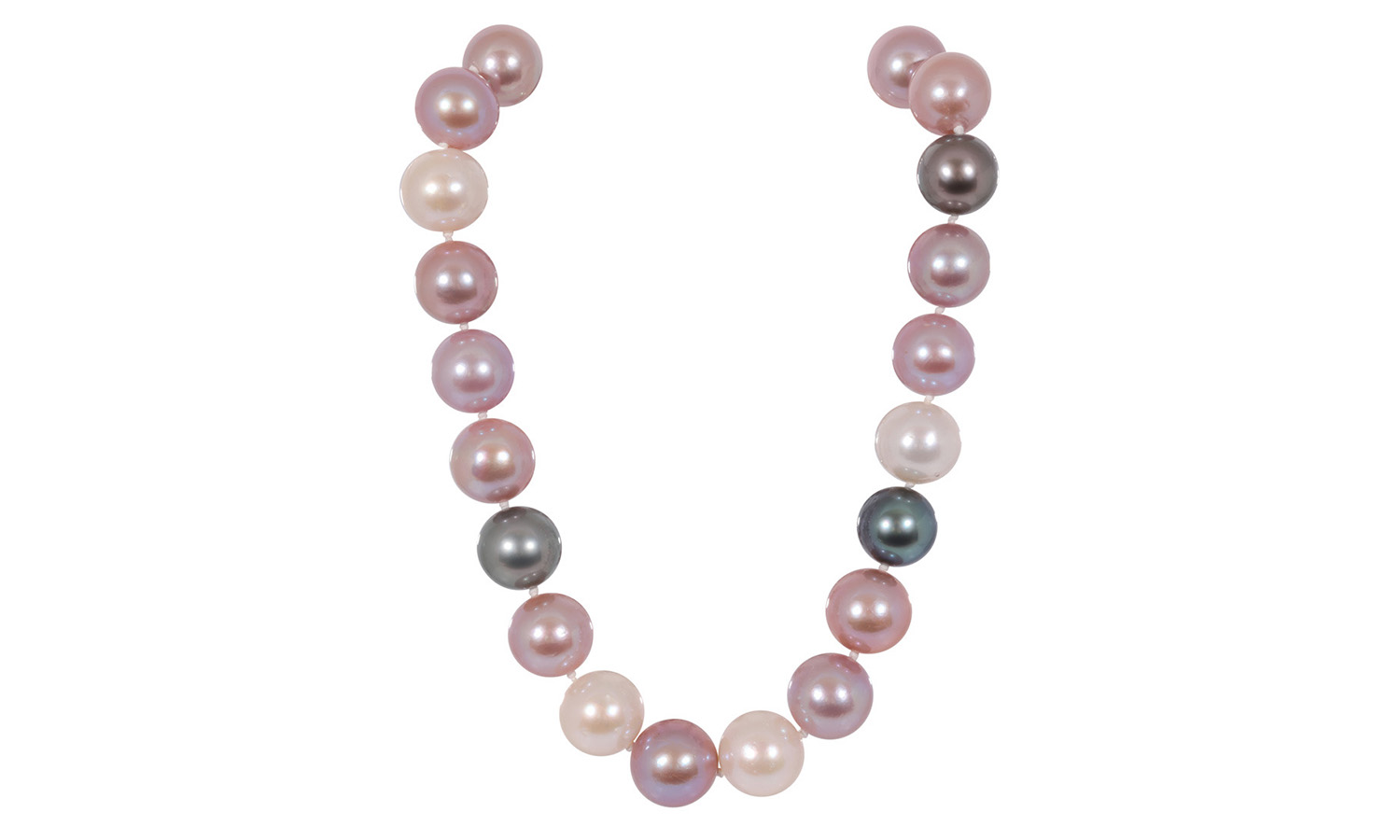
Elegant Tahitian & Freshwater Pearl Non Graduated Necklace with 12-13mm Pearls
Pearl Shapes and Colours
Perfectly round pearls have traditionally been considered the most valuable, but modern jewellery has embraced more organic pearl shapes too.
Today, baroque pearls are especially popular because every pearl is unique. Their irregular shapes give jewellery a more relaxed, individual look that works beautifully in contemporary designs.
Pearls are also available in far more colours than many people realise, including:
- White
- Cream
- Pink
- Peach
- Silver
- Gold
- Grey
- Green
- Black
The exact colour depends on the mollusc species and the environment in which the pearl develops.

What Makes a Good Pearl?

18ct White Gold Akoya Pearl and Marquise Diamond Drop Earrings, Pendant and Ring (also shown below)
Unlike diamonds, pearls do not follow one universal grading system. However, jewellers usually look at several key factors when assessing pearl quality.
Lustre
Lustre is one of the most important things to look for in a pearl. The better the lustre, the brighter and more reflective the pearl appears. High quality pearls almost seem to glow when they catch the light.
Surface Quality
Because pearls are natural gemstones, small surface imperfections are normal. Generally speaking, the cleaner the surface, the more valuable the pearl.
Shape
Round pearls are traditionally the rarest and most valuable, although well-shaped baroque pearls are increasingly sought after in modern jewellery.
Size
Larger pearls are usually more valuable, particularly when combined with excellent lustre and a smooth surface.
How Can You Tell if Pearls Are Real?

Freshwater Pearls are available in many different shapes
Imitation pearls can look convincing at first glance, but there are usually a few easy ways to spot the difference.
One of the simplest tests is to gently rub two pearls together. Genuine pearls feel slightly gritty because of their layered nacre surface, while imitation pearls feel perfectly smooth and glide against one another.
Real pearls also tend to have tiny natural variations in shape, size, or surface texture. Imitation pearls are often overly uniform.
You may also notice that genuine pearls feel slightly cooler and heavier when held.
Interesting Pearl Facts
- Pearls are the only gemstones formed by living creatures
- Freshwater pearls are grown in mussels rather than oysters
- Baroque pearls are loved for their irregular, one-of-a-kind shapes
- The colour of a pearl depends on both the mollusc species and its environment
- Climate change and rising ocean temperatures are creating challenges for pearl farming
- One of the world’s most famous pearls, La Peregrina, was once owned by Elizabeth Taylor
- Pearls benefit from being worn regularly, as natural skin oils help prevent them from drying out

18ct Gold Freshwater Pearl Graduated Pendant and Drop Earrings
Caring for Pearl Jewellery

Using a soft cloth to clean our Jersey Pearl Classic Grey Pearl Necklace
Pearls are softer than many other gemstones, so they do require a little extra care.
To help keep pearl jewellery looking its best:
- Store pearls separately from harder jewellery
- Avoid spraying perfume directly onto pearls
- Wipe pearls gently after wearing
- Put pearl jewellery on last when getting ready
- Restring pearl necklaces periodically if worn regularly
With the right care, pearl jewellery can last for generations.
Discover Pearl Jewellery at Zelley Jewellers
Whether you prefer timeless pearl studs, elegant pendants, or more contemporary pearl designs, pearls remain one of the most versatile gemstones in jewellery.
At Zelley Jewellers, we offer a beautiful collection of pearl jewellery to suit both classic and modern tastes. Explore our latest pearl pieces online or visit us in store to discover the timeless appeal of pearls for yourself.